Solar Financing vs Cash Purchase Comparison: Key Savings Guide
You open your monthly electric bill and feel a familiar knot in your stomach. The number keeps climbing year after year, and you wonder if there is a way to finally break free from the cycle of rising utility costs. Many homeowners in your situation are now searching for a solar financing vs cash purchase comparison to find the most affordable path to lower energy bills and greater energy independence.
Solar energy offers a proven way to reduce your electricity bills and become less dependent on the local power grid. But deciding how to pay for a solar panel system can feel overwhelming. Should you pay cash upfront and enjoy immediate savings, or use a solar loan or lease to spread the cost over time? This guide breaks down both options in clear, simple language so you can make a confident choice.
Understanding solar financing vs cash purchase comparison
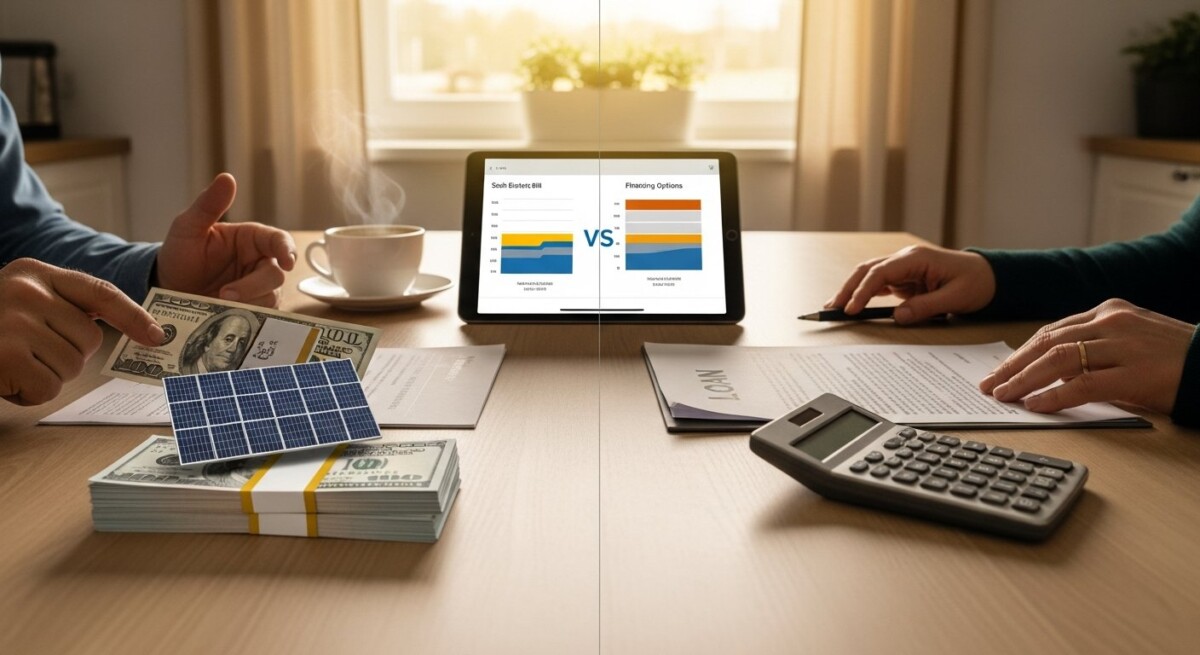
At its simplest level, a solar financing vs cash purchase comparison helps you weigh two different ways to own or use solar panels on your home. When you pay cash, you buy the system outright and own it from day one. When you finance, you borrow money through a solar loan, lease, or power purchase agreement (PPA) to cover the upfront cost.
With a cash purchase, you receive the full financial benefits, including the federal solar tax credit and any state or local rebates, directly. You also start saving on electricity immediately because your only cost is the system itself. Financing options lower your upfront payment but reduce your monthly savings because you must make loan payments or lease fees alongside your reduced utility bill.
More homeowners are considering both paths because solar panel prices have dropped significantly over the past decade, while electricity rates continue to rise. According to industry data, residential solar installations have grown by more than 20 percent annually in recent years, driven by falling equipment costs, attractive incentives, and growing awareness of long-term savings.
How solar loans differ from leases and PPAs
A solar loan is similar to a home improvement loan: you borrow money, own the system, and repay the loan with interest over five to twenty-five years. With a lease or PPA, you do not own the panels; instead, you pay a fixed monthly fee or a per-kilowatt-hour rate to use the electricity they generate. Ownership through a loan or cash purchase typically yields the greatest long-term savings.
Why Solar Energy Is Becoming More Popular
Rising electricity prices are the number one reason homeowners switch to solar. The average residential electricity rate in the United States has increased by roughly 15 percent over the past five years, and many experts expect that trend to continue. Solar panels protect you from those hikes by generating your own power.
Environmental concerns also play a major role. Solar energy produces no greenhouse gases during operation, helping homeowners reduce their carbon footprint. At the same time, government incentives such as the federal Investment Tax Credit (ITC) allow you to deduct 30 percent of your solar installation cost from your federal taxes, making the switch more affordable than ever.
Long-term savings are the final piece of the puzzle. Most solar panel systems pay for themselves within six to ten years, then provide free electricity for the remaining twenty or more years of their lifespan. That kind of financial return is hard to find with any other home improvement project.
If you are considering solar power for your home, comparing installation quotes can help you understand your options. Request a free solar quote or call to learn more.
Common Questions Homeowners Have About Solar
Solar energy is a big investment, and it is natural to have questions before moving forward. Most homeowners worry about installation cost first, but they also want to know if their roof is suitable and how the system will perform in different weather conditions.
Understanding the answers to these common concerns can help you feel more confident about your decision. Professional solar installers are trained to evaluate your specific situation and recommend the best system size and financing option for your home.
- How much does a solar panel system cost for an average home?
- Will solar panels work on a shaded or older roof?
- How long does it take for solar panels to pay for themselves?
- What happens to solar savings when I sell my home?
- Do solar panels require a lot of maintenance?
- Can I get solar if I have a low credit score?
How Solar Panel Installation Works
Solar panel installation follows a straightforward process that typically takes one to three days once everything is approved. The first step is a home energy assessment, where an installer reviews your electricity usage, roof condition, and sunlight exposure to design a system that meets your needs.
After the assessment, the installer creates a custom system design, handles permits and approvals, and schedules the installation. On installation day, the crew mounts the panels on your roof or ground, connects them to an inverter, and wires the system to your electrical panel. A final inspection and utility approval activate the system.
- Home energy assessment and usage analysis
- Custom system design and equipment selection
- Permit applications and utility approvals
- Panel and inverter installation
- Final inspection and system activation
Speaking with experienced installers can help you determine the best solar solution for your home. Compare solar quotes here or call to explore available options.
Signs Your Home May Be Ideal for Solar
Not every home is equally suited for solar panels, but most homes in sunny regions can benefit. The best candidates have roofs that face south, west, or east with minimal shading from trees or nearby buildings. If your roof is older, you may need to replace it before installing panels.
High electricity bills are another strong indicator that solar could save you money. Homes that use more than 500 kilowatt-hours per month often see the fastest payback periods. If you plan to stay in your home for at least five to seven years, solar panels generally make financial sense.
- Your roof gets strong sunlight for most of the day
- Your monthly electricity bills exceed $100
- You have at least 300 square feet of usable roof space
- Your roof is less than 10 years old or in good condition
- You plan to stay in your home for five or more years
- Your local utility offers net metering or solar incentives
What Affects Solar Installation Costs
Solar installation costs vary based on system size, equipment quality, and installation complexity. A larger system that covers 100 percent of your electricity needs costs more upfront but delivers greater long-term savings. High-efficiency panels and premium inverters also add to the price but often produce more power over time.
Local factors matter too. Some states offer generous rebates or performance-based incentives that lower your out-of-pocket cost. The complexity of your roof, such as steep slopes, multiple stories, or unusual materials, can increase labor costs. Getting multiple quotes helps you understand the fair market price for your area.
The cost of solar installation varies depending on your home and energy needs. Request personalized solar quotes or call to see what options are available.
Tips for Choosing a Reliable Solar Installer
Choosing the right installer is just as important as choosing the right financing option. A reliable installer will conduct a thorough site assessment, explain your financing choices honestly, and provide a clear contract with no hidden fees. Look for companies that have been in business for at least five years and hold certifications from organizations like the North American Board of Certified Energy Practitioners (NABCEP).
Warranties are another critical factor. Most quality solar panels come with a 25-year performance warranty, and the inverter should be covered for at least 10 years. A strong workmanship warranty of 10 years or more protects you if installation issues arise. Reading online reviews and asking for references can also give you peace of mind.
- Review the installer’s experience and NABCEP certification
- Check product and workmanship warranty terms
- Read recent customer reviews on Google or EnergySage
- Compare at least three quotes from licensed installers
Long-Term Benefits of Installing Solar Panels
Lower electricity bills are the most immediate benefit of going solar. After your system is paid off, you enjoy free electricity for the remaining lifespan of the panels, which is typically 25 to 30 years. Over that time, you could save tens of thousands of dollars depending on your local utility rates and system size.
Solar panels also increase your home’s value. Studies from the National Renewable Energy Laboratory show that homes with solar sell for about 4 percent more than comparable homes without solar. Buyers appreciate the reduced utility bills and energy independence that come with an existing system.
Beyond financial gains, solar energy reduces your household’s environmental impact. Each kilowatt-hour of solar power avoids about 0.9 pounds of carbon dioxide emissions compared to grid electricity. For a typical 6-kilowatt system, that adds up to roughly 100 tons of CO2 avoided over its lifetime. Energy independence also protects you from future rate hikes and power outages when paired with battery storage.
How long do solar panels last?
Most solar panels come with a 25-year performance warranty, but they often continue producing electricity for 30 years or longer. Output gradually decreases over time, typically by about 0.5 percent per year, so you can expect reliable energy production for decades.
Can I get solar financing with bad credit?
Some solar lenders offer financing options for homeowners with less-than-perfect credit, though interest rates may be higher. Leases and PPAs often have less stringent credit requirements because the installer retains ownership of the system. Shopping around and comparing financing offers can help you find an option that works.
What is the federal solar tax credit for 2024?
The federal Investment Tax Credit (ITC) allows you to deduct 30 percent of your solar installation cost from your federal income taxes. This credit applies to systems installed through 2032, then gradually decreases. If your tax liability is less than the credit amount, you can roll over the unused portion to the next tax year.
Is it better to lease or buy solar panels?
Buying solar panels, either with cash or a loan, almost always provides greater long-term savings than leasing. With a lease, you do not qualify for the federal tax credit or other incentives, and your monthly savings are typically smaller. Buying gives you full ownership and maximum financial returns.
How much can I save on electricity with solar?
Savings vary based on your location, system size, and utility rates. On average, homeowners save between $600 and $2,000 per year on electricity bills. Over 25 years, total savings often range from $15,000 to $50,000 after accounting for system costs and incentives.
Do solar panels work during a power outage?
Standard grid-tied solar systems shut down during a power outage to protect utility workers. If you want backup power during outages, you need a solar battery storage system like the Tesla Powerwall or LG Chem RESU. Batteries store excess solar energy for use when the grid goes down.
What happens to my solar panels if I sell my home?
If you own your solar panels, they typically add to your home’s resale value and transfer to the new owner. If you lease the system, the new buyer must qualify to take over the lease, which can complicate the sale. Buying your system outright simplifies selling your home later.
How do I compare solar installation quotes?
When comparing quotes, look at the total system cost, equipment brands and warranties, financing terms, and estimated energy production. A lower price does not always mean better value if the equipment or installation quality is inferior. Getting multiple quotes from certified installers helps you find the best combination of price and quality.
Deciding between solar financing and a cash purchase depends on your budget, goals, and timeline. Both paths can help you reduce electricity bills, gain energy independence, and lower your environmental footprint. The most important step is to start comparing quotes from reputable installers who can tailor a system to your home and needs.
Take the first step today by requesting quotes from multiple solar providers. The sooner you compare your options, the sooner you can start saving on electricity and enjoying the benefits of clean, renewable energy.